Current campaign


PT-002Caregiver 1.2.19 · extended field passNadeem · 12 new findings · response build ready
1Extracted bug reportSanitized field observations
Contributor impact
Nadeem expanded the test surface.
This pass covered profile media, QR pairing, task ownership, mesh counts, supply state, dashboard navigation, demand planning, and offline AI. It added twelve findings and independently closed one earlier question.
- New findings
- 12
- Earlier closes
- 1
- Workflow areas
- 8
Care-record profile image does not appear
An added profile image is missing from the care record. Retest must distinguish save failure from render failure after reload.
Admission warning conflicts with a working paired session
The bedside screen briefly reported that it was not admitted while its assistance request still reached the caregiver workspace.
An open assistance request cannot be claimed
The Claim control appeared unavailable on an active request, blocking the caregiver from assigning and resolving it.
Critical counter exceeds the visible care context
The mesh summary reported two critical items with one synthetic patient and no explanation of what contributed to the count.
A depleted-supply warning appears twice
The same first-aid supply shortage rendered as two identical alert cards.
Supply warning remains after restock
The depleted warning did not clear after stock rose above its alert threshold.
An unclaimed assistance request can be silently dismissed
An open request closed immediately without being claimed, confirmed, or given a resolution record. A genuine care need could disappear before anyone acts on it.
Care Home summary cards do not navigate
The four summary cards do not open or filter their related work areas.
Mesh summary counters have no drill-down
Ward, patient, and critical counters do not reveal the records behind their totals.
Critical counter stays stale after resolution
The count remained elevated after the related item was resolved, indicating that the summary does not react to underlying state changes.
A water request is absent from the Need calculation
The planning chart continued to show zero water need after a bedside request. Triage must confirm whether Need represents planned demand, live requests, or both.
A follow-up offline AI response does not complete
The first response completed, but the next short message remained in generation for more than three minutes.
2Build responseWhat changed and what must be retested
Response buildHALT Caregiver 1.2.22Signed and published after the full Rust suite, production build, embedded-signature, and public-download gates passed. Organization and Community 1.2.22 are also ready for the ecosystem sprint.
Download response build
Protected care-record media now loads through the authorized path
Desktop views read attachment bytes through the native command; browser views use the admitted field session. Profile photos and attachment previews no longer depend on an unauthenticated image URL.
Recovered bedside sessions clear stale admission warnings
A successful identity refresh or mesh connection now removes the earlier transient error instead of leaving a red warning beside a working request.
Claim now carries the signed caregiver identity
The Claim action supplies both the member ID and display name required by the shared task core, updates the board immediately, and shows a useful error when network identity is missing.
The counter represents supply risk, not critical patients
The ambiguous “Critical” label is now “Supply risks.” Duplicate stock records are rolled into one alert position so the total communicates what it actually measures.
Equivalent stock records produce one shortage alert
Alert calculations group the same named item by location and purpose, while new duplicate entries redirect the user to the existing stock card.
Restock changes refresh the alert surfaces immediately
Add, consume, restock, and delete operations now notify the dashboard and planning chart; the rolled-up alert clears when combined stock rises above its threshold.
Active assistance requests cannot be silently removed
The UI exposes removal only after completion or cancellation, asks for confirmation, and the shared Rust core independently rejects deletion of an active assistance request.
Care Home summary cards now open their work
People and stock cards navigate to their records; assistance and task cards expand the task board with the relevant view.
Mesh counters now drill into care or supplies
Ward and patient totals open the care timeline. Supply-risk totals open Supplies, with labels that match the destination.
Supply risk no longer masquerades as unresolved care
Resolving a patient request does not change an unrelated stock warning. Stock mutations now refresh the correctly named supply-risk count without waiting for polling.
Open supply requests contribute to live Need
The planning chart now combines care-plan demand with unresolved assistance requests, including water and hydration matches.
Offline inference can no longer spin without a boundary
Quick responses stop after 90 seconds and deep analysis after 180 seconds, cancel the local stream, and return a retryable message. The original second-turn stall still requires verification on the packaged runtime.
PT-001Caregiver 1.2.19 · build v8aWarren / Nadeem · 11 findings · F-005 verified
1Extracted bug reportWhat the tester found
Contribution evidenceThe work behind PT-001.
Each capture connects this tester’s fieldwork to the findings below.
Name accepts arbitrary symbols
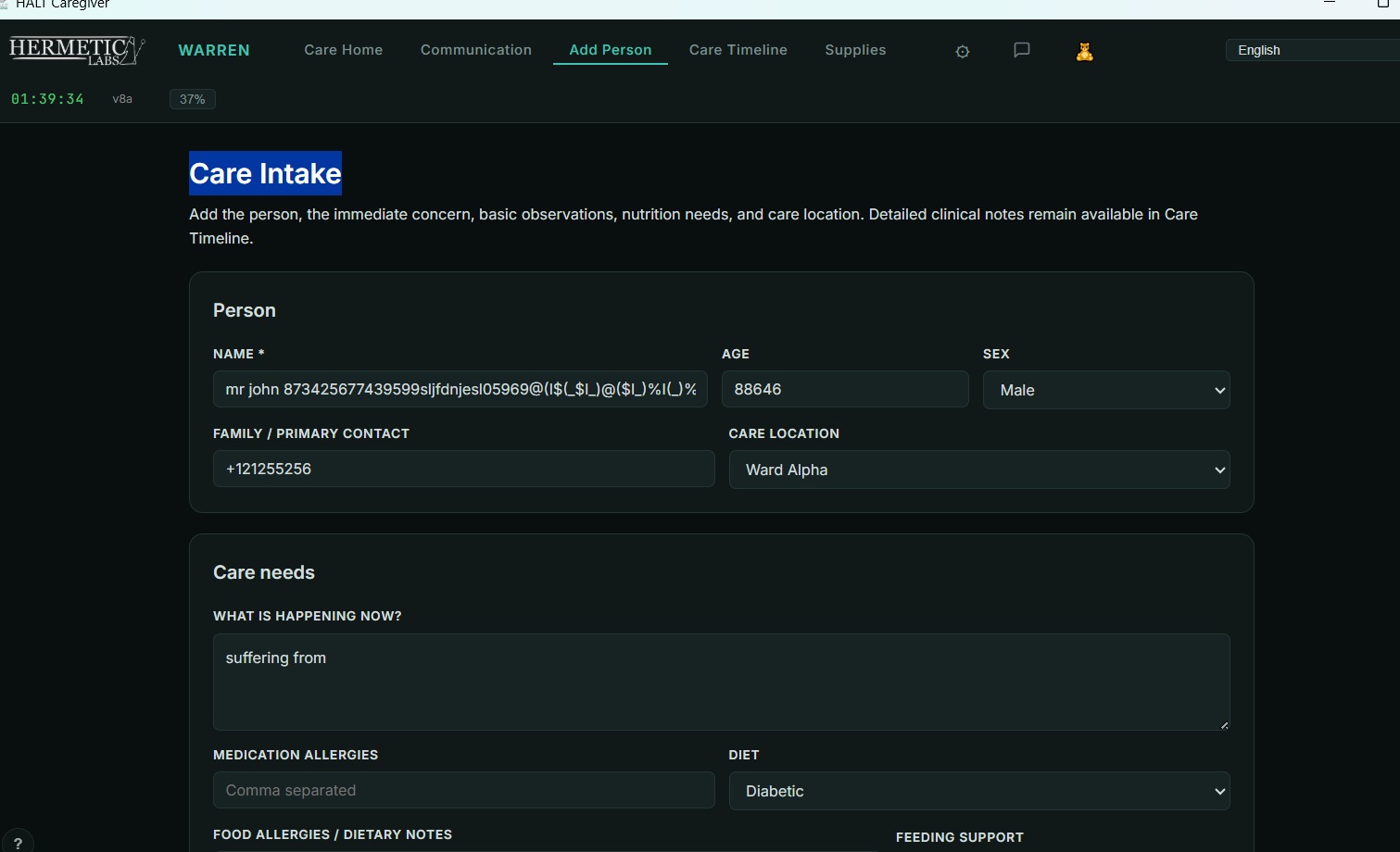
Identity input saves malformed text without format or length controls.
Primary-contact input is unclear and unvalidated
The field accepts malformed text and does not explain whether it expects a name, phone number, or both.
Impossible age is accepted
Age 999 saves without warning or a realistic range check.
Stored-script safety needs complete retesting
A synthetic script payload still needs verification across every display and export surface.
Dashboard tiles may remain at zero
A controlled add-person retest is needed to distinguish refresh behavior from incorrect counting.
Age displays as a corrupted overflow value
The patient view showed 3268586758386868600000 years after extreme input.
Unset weight displays as 0 kg
Missing information is presented as an entered clinical value.
Injury time displays as raw ISO text
The timestamp is inconsistent with the nearby formatted admission time.
All four vital fields accept impossible values
Heart rate, systolic BP, SpO2, and temperature save values far outside valid ranges.
Family Lookup defaults to visible
A new record becomes visible to family search without an explicit tester choice.
Free-text fields accept unbounded garbage strings
The data-quality and safe-output pattern extends across condition, dietary, and general notes.
2Build responseWhat changes and what must pass
Response buildHALT Caregiver 1.2.21Signed · immutable · ready for Warren / Nadeem to verify
Download response build
Safe, realistic identity input
Names are required, capped at 200 characters, and reject control characters. Unicode, apostrophes, and hyphens remain valid by design; output encoding handles unsafe markup.
Contact purpose is explicit
The field now says “name or phone,” includes an example, and applies a 500-character/control-character boundary while remaining optional.
Impossible ages stop before save
Caregiver accepts whole-year ages from 0–130 only, with the same range enforced again by the shared core.
The real stored-script sinks are closed
React already rendered normal screens as text. The patient and shift-handoff HTML exports were the exposed paths; patient-controlled values are now encoded and covered by a script-payload regression test.
Dashboard counting works as designed
The follow-up field pass confirmed that all four summary values updated after adding a synthetic care record and submitting an assistance request.
Unbounded age pass-through is blocked
This was not an integer overflow: the extreme number was stored and displayed as entered. UI and core boundaries now reject it.
Missing weight reads as missing
An unset weight now displays as an em dash instead of “0 kg,” and the editor accepts only blank or 0.1–1000 kg.
Injury time matches admission time
Both timestamps now use the same guarded local date-and-time formatter; invalid legacy text remains visible instead of crashing the panel.
Vitals have field-specific safety boundaries
Caregiver and the shared save boundary reject impossible heart rate, systolic BP, SpO₂, and temperature values. Missing observations no longer become fake normal graph points.
Family Lookup is explicit opt-in
New Caregiver records now start hidden. Visibility changes only when the checkbox is deliberately enabled.
Free text is bounded without breaking languages
Concern, dietary notes, general notes, allergies, and contact text now have appropriate size/control-character limits; exports encode the saved content.
Public-safe summary. Raw test inputs, synthetic record names, screenshots, network details, and internal evidence remain in the controlled handoff record.